Tokyo Host Clubs for Foreigners: ¥3,000 First Visit, ¥36,000 After
Yes, foreigners can visit. First visit: a median of ¥3,000 across 75 Kabukicho clubs. Second visit: a median of ¥36,000. Costs, safety, street touts and the 2025 law.
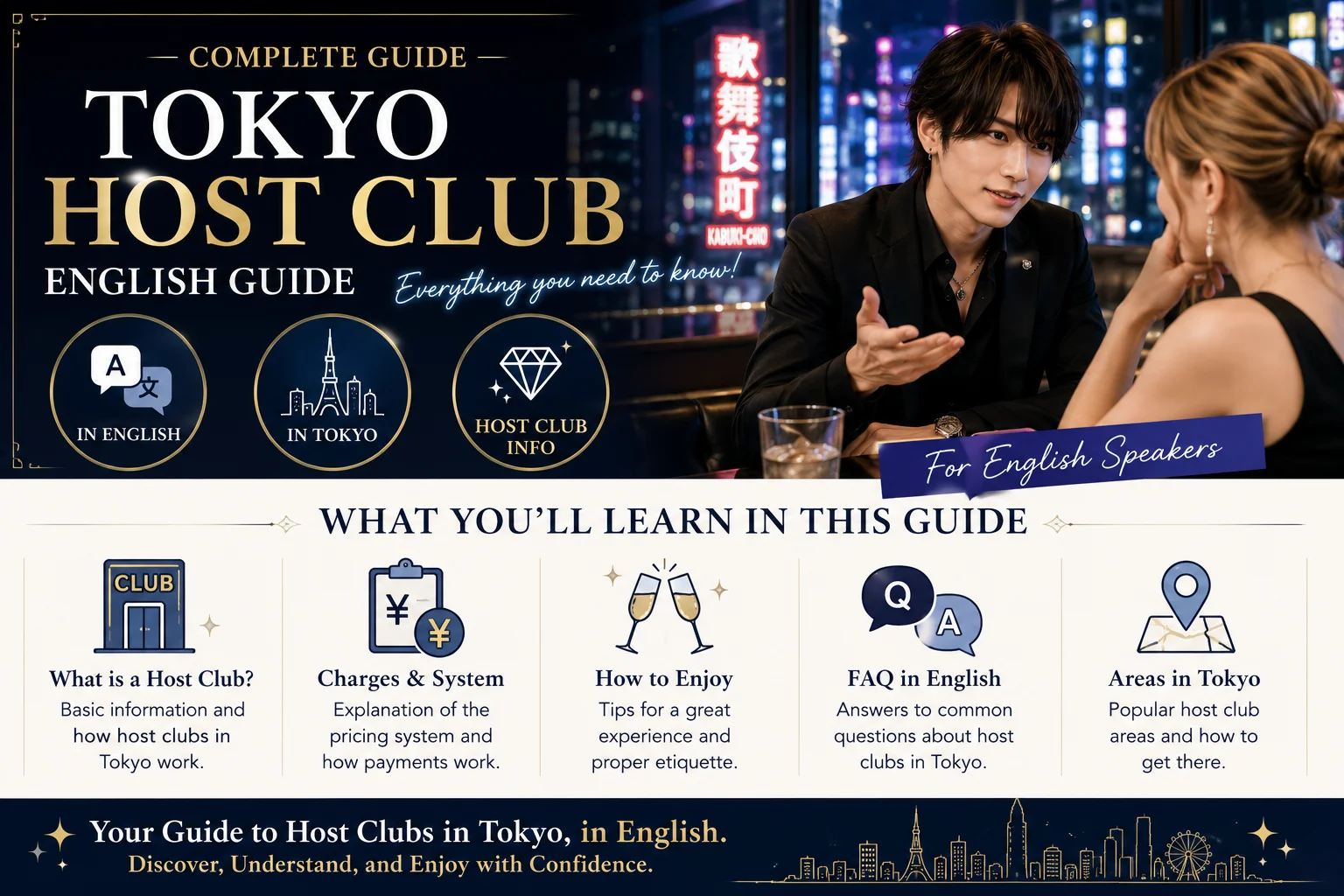
Can Foreigners Visit a Tokyo Host Club? Yes — Here's How
Yes — foreign visitors can absolutely experience a Tokyo host club, and in 2026 it is easier than ever. This is the guide from the HostRank editorial team in Kabukicho: how to actually go, what it really costs (a median of ¥3,000 on the first visit — and roughly twelve times that on the second), the language barrier and English-friendly clubs, solo-female safety, the 2025 law change, and the one real risk worth avoiding — street touts.
Quick check before you go — a host is not a hostess. A host club = male staff entertaining female guests. A hostess club / kyabakura (キャバクラ) = female staff for male guests. If you are a woman who wants to be entertained by charming Japanese men over drinks and conversation, you are in the right place. (Men looking for female-staff venues want kyabakura — this is not your guide.)
Tokyo's Kabukicho in Shinjuku is the world's densest host-club district. A full count of the district in July 2026 found 243 host clubs. Below we answer every question foreign visitors actually ask in 2026 — starting with whether you can go and how, then cost, the language barrier, the exact first-visit flow, and safety.
What Is a Host Club?
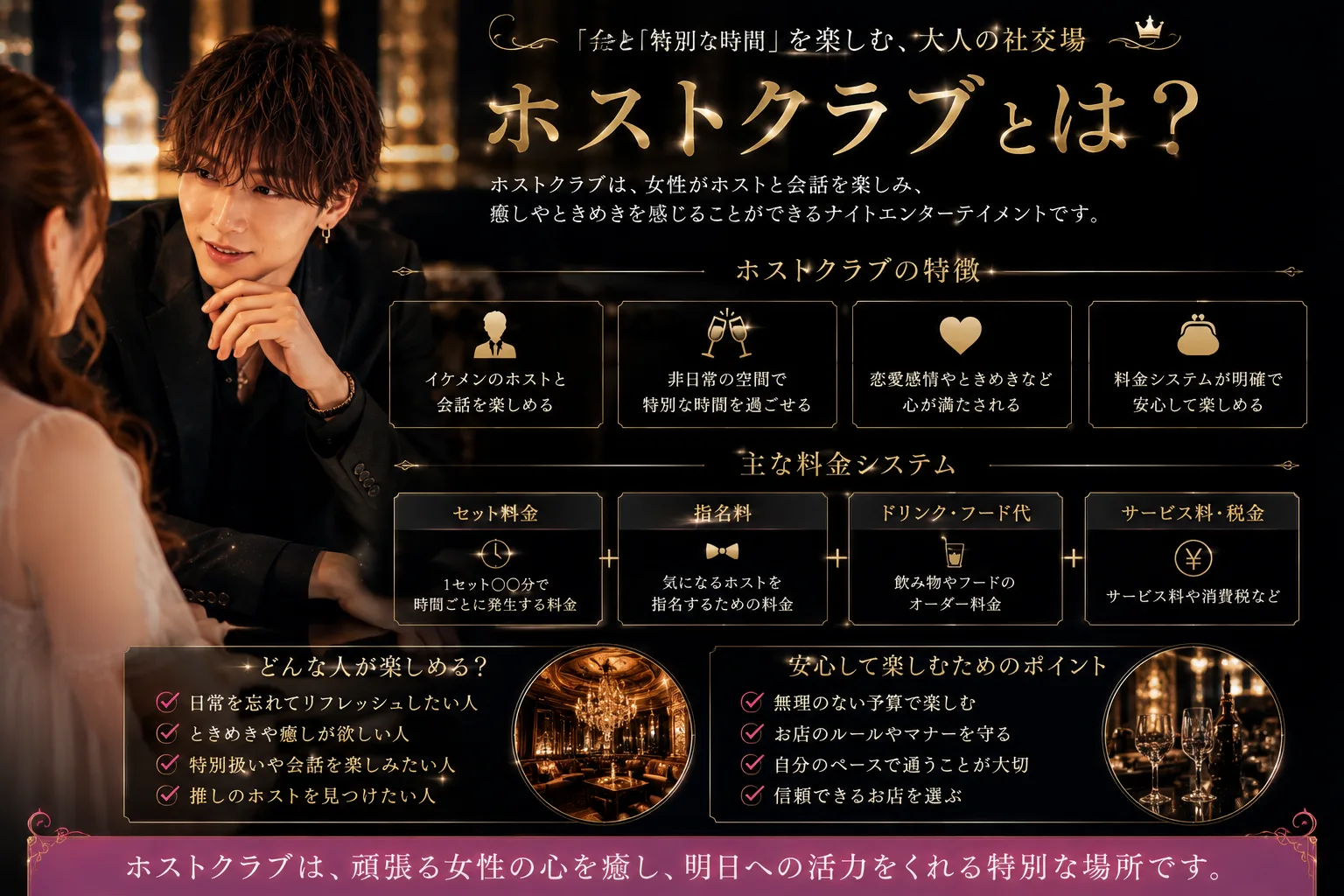
A host club (ホストクラブ, hosuto kurabu) is a nightlife venue where male hosts entertain female customers through conversation, drinks, and a theatrical, pampering atmosphere. The core "product" is not romance or anything physical — it is professional conversation and the feeling of being treated like royalty for an hour or two. Hosts are trained entertainers, closer to a stage performer or a personal concierge than a date.
| Host Club | Hostess Club (Kyabakura) | |
|---|---|---|
| Staff gender | Male | Female |
| Customer gender | Female | Male |
| Atmosphere | Romantic, dramatic, theatrical | Casual, conversational |
| Champagne culture | Very prominent | Lighter |
| First-visit price | ¥1,000〜¥5,000 (median ¥3,000) | Varies; we have not measured it |
A Short History (1965 to Today)
The first host club is generally traced to 1965, when a venue called Night Tokyo opened in front of the Yaesu exit of Tokyo Station — not in Kabukicho, and not in Akasaka as some English sources say. The industry migrated to Kabukicho through the 1970s–80s, produced the media-famous "charisma host" era in the 1990s–2000s, went social-media-driven in the 2010s, and entered a regulation-and-refinement phase in the 2020s (see the 2025 law section below). Today Kabukicho holds the vast majority of Japan's host clubs, and the culture is globally known through manga, dramas, and YouTube.
Types of Hosts You'll Meet
You don't need to memorize these, but knowing the rough archetypes makes the photo catalog less overwhelming: the bright/energetic type who runs the table, the calm/listening type who lets you talk, the intellectual type good at deep conversation, the idol/visual type who leans on looks and SNS, and the older/dandy type for a mature, settled mood. On a first visit you'll meet several through rotation, so you can compare in person rather than guessing from a photo.
Common Misconceptions (Worth Unlearning Before You Go)
A few myths that put foreign visitors off for no reason. "It's basically prostitution" — it is not; physical services are not part of host clubs and are illegal. "Customers all fall in love and ruin their lives" — problem cases exist and get media attention, but a one-time first visit at a reputable club is low-risk and pressure-free. "Only rich people can afford it" — the first-visit plan is roughly the price of a cinema ticket. "It's shady/illegal" — host clubs are licensed businesses regulated under the Entertainment Business Act. Knowing this, the experience is simply a fascinating slice of Japanese nightlife.
How Much Does It Cost?
Price is the number-one anxiety, so here are the numbers we counted ourselves from the price lists Kabukicho clubs publish.
The first visit is cheap. The second one is not. That gap is the single thing visitors get wrong, so we will take it in two parts.
The first visit: a median of ¥3,000
The first-visit plan ("shokai", 初回) is a one-off trial rate, far below normal pricing. All 77 Kabukicho clubs on HostRank publish a first-visit price; 75 of them publish an ordinary one, and across those the median is ¥3,000.
| First-visit price | Clubs |
|---|---|
| ¥1,000 | 4 |
| ¥2,000 | 20 |
| ¥3,000 | 49 |
| ¥4,000 | 1 |
| ¥5,000 | 1 |
97.3% charge ¥3,000 or less, and the highest ordinary first-visit price we found was ¥5,000. You will see "from ¥1,000" advertised — that is true of four clubs, not of the district.
The two clubs left out of that table are worth knowing about, because one of them is a name you will have seen. TOP DANDY and TOP DANDY 別館 do not sell a cheap trial hour at all: their first-visit offer is a plan with a bottle of champagne or wine included, at ¥30,000 for two hours and ¥15,000 for 90 minutes respectively. Nothing is hidden and nothing is wrong with that — but if you walk into the most famous name in Kabukicho expecting ¥3,000, you have the wrong club for a cheap first look.
It usually buys 60 minutes, with soft drinks and house spirits included and several hosts rotating through your table. At most clubs the service charge and consumption tax are already inside that figure; the price lists say so explicitly. It commits you to nothing.
Every visit after that: a median of ¥36,000
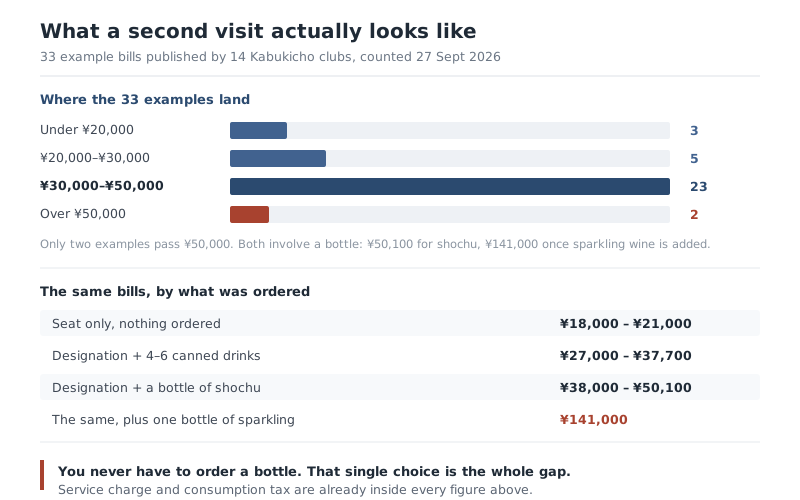
14 Kabukicho clubs publish worked example bills. Across the 33 examples they list, the median is ¥36,000 and the range is ¥18,000 to ¥141,000.
| What was ordered | The bill |
|---|---|
| Seat only, nothing ordered | ¥18,000–¥21,000 |
| Designation + 4–6 canned drinks | ¥27,000–¥37,700 |
| Designation + a bottle of shochu | ¥38,000–¥50,100 |
| The same, plus one bottle of sparkling | ¥141,000 |
23 of the 33 examples land between ¥30,000 and ¥50,000. Only two pass ¥50,000, and both involve a bottle. Service charge and consumption tax are already included in every figure above.
Read that top row again: ¥18,000 even if you order nothing at all. That is the floor, and it is roughly six times the first visit.
What gets added on top
On the normal menu, the seat fee and the drinks are only part of it. Across the Kabukicho price lists we read, a service charge of 35% is the most common (some clubs list 30%, 37%, 38% or 40%), and 10% consumption tax is charged separately. Treat it as roughly 45% on top.
For reference, the median published seat fee in Kabukicho is ¥7,000 and the median designation fee is ¥3,000 — before that 45%.
Bottles are optional and they are the whole gap. We do not publish bottle prices here, because clubs rarely publish them and the figures circulating online have no traceable source. What the example bills do show is that one bottle can turn a ¥40,000 night into a ¥141,000 one. You never need to order one, least of all on a first visit.
We have deliberately left out dollar and euro conversions: the rate moves, and a stale table is worse than none. Convert the yen figures yourself on the day.
"Can Foreigners Even Go?" — Yes, and Here's the Reality
The short answer is yes. Foreign visitors are welcome at most clubs, and the worries that stop people are mostly unfounded.
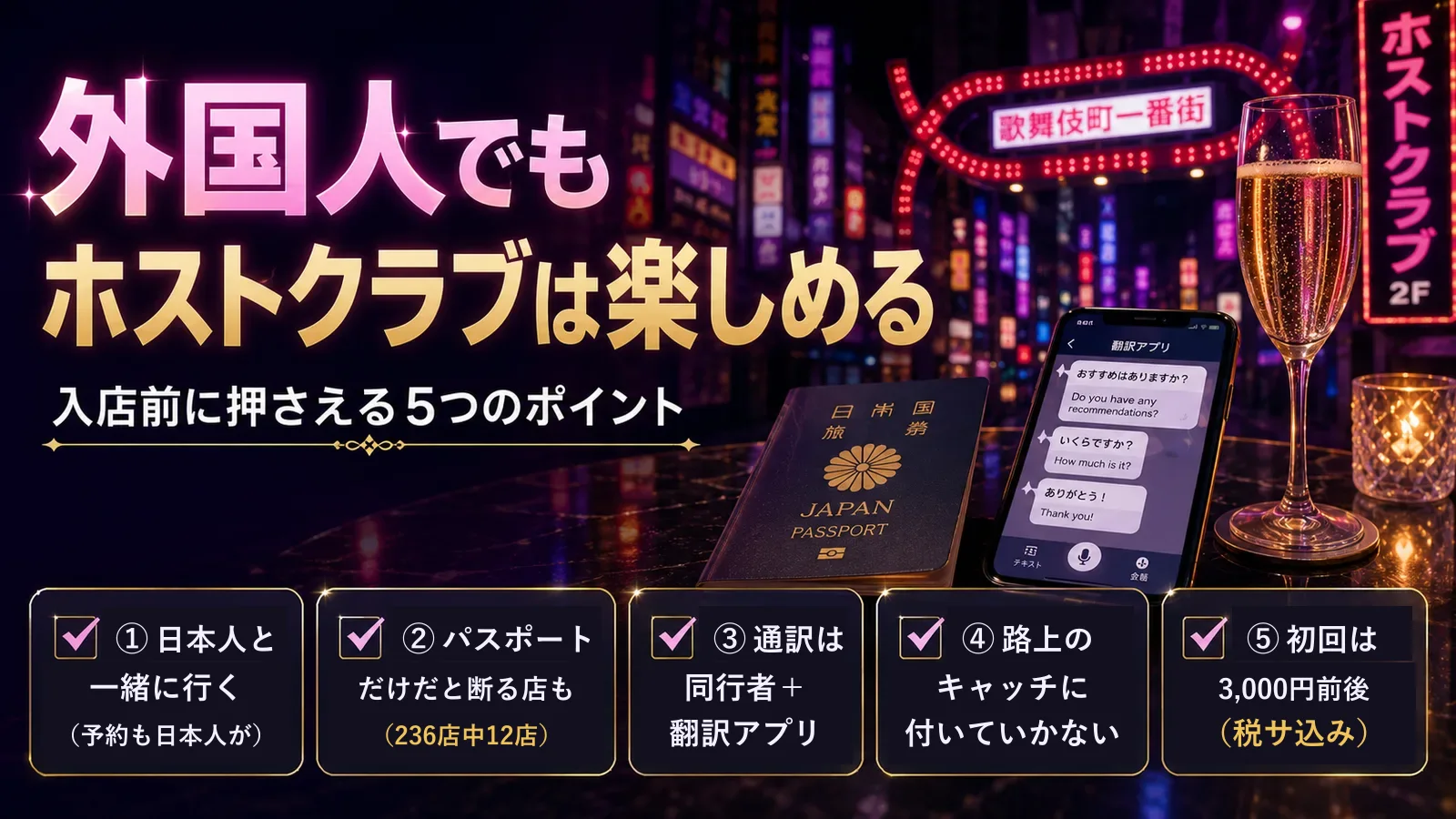
"They'll turn me away for being foreign." Clubs don't refuse guests for their nationality as a rule. What actually gets tourists turned away is ID: of the 236 Kabukicho clubs that publish price pages on the listing site Hosuhosu (September 2026), 12 set ID rules a foreign passport alone can't meet — a passport with an address written in it (foreign passports have no address field), or a passport plus a Japanese health-insurance card. Choose a club that names the passport as accepted ID, or ask when you book.
"I'll be charged more for being foreign." Not at reputable clubs — the first-visit price is fixed and collected upfront. Inflated "foreigner pricing" is a street-tout problem, not a real-club problem (see touts below).
"The language barrier is impossible." It is the real friction point, but manageable. Most hosts speak only Japanese, and English-speaking hosts are genuinely rare. The most reliable fix is to go with a Japanese-speaking friend who can interpret and make the booking. Google Translate and DeepL help with menus and short phrases, but they won't carry a fast conversation on their own. If you have no Japanese-speaking friend, Smappa!Group runs a "Kabukicho Concierge" service for international visitors, with English-speaking staff.
"It might be unsafe or a scam." Legitimate clubs are very safe (see safety and law sections). The only real scam vector is street touts — never the clubs you book yourself.
A handful of memorizable phrases removes most stress:
| Japanese | Romaji | Meaning |
|---|---|---|
| 初回でお願いします | Shokai de onegai shimasu | "First-visit plan, please" |
| 英語話せますか? | Eigo hanasemasu ka? | "Can you speak English?" |
| お酒飲めません | Osake nomemasen | "I can't drink alcohol" |
| お会計お願いします | Okaikei onegai shimasu | "The bill, please" |
| クレジットカード使えますか? | Kurejitto-kādo tsukaemasu ka? | "Do you take credit cards?" |
| まだ決めていません | Mada kimete imasen | "I haven't decided yet" (declining a designation) |
Hosts respond warmly even to awkward pronunciation — don't stress over it.
How to Choose Your First Club
Four criteria. Check real reviews on a platform like HostRank rather than trusting ads. Confirm the first-visit price is publicly displayed — transparent pricing signals a trustworthy club. Pick a major-group club (groupdandy, AIR GROUP, L's collection, Smappa! Group, ACQUA Group) for predictable pricing, professional management, better English odds, and higher safety standards. And never follow street touts — more on that below, because it is the single most important rule in this guide.
The First Visit, Door to Door (Minute by Minute)
Knowing the exact flow removes almost all anxiety. This is a typical Kabukicho major-group club — TOP DANDY, AXEL by ACQUA and DOLCE1 all run this way — as of September 2026.
00:00 — The building. Most clubs occupy floors 2–5 of a multi-tenant building on Hanamichi-dori (花道通り), Suzuran-dori (すずらん通り), or Sakura-dori (さくら通り). A small electronic signboard shows the logo at street level. Take the elevator; some require a passcode the staff give you when you book.
00:01 — The door. A black-suited manager ("kuro-fuku", 黒服) greets you. Say "Shokai de yoyaku shita [name] desu" (初回で予約した○○です). They confirm your booking on a tablet.
00:02 — ID check. Bring your passport (a few clubs won't accept a foreign passport on its own, so check the club's ID rules before you go). The law itself sets the entry age at 18 (Entertainment Business Act, art. 22(1)(v) bars under-18s), and separately bars serving alcohol to anyone under 20 (art. 22(1)(vi)). In practice the major groups go further and refuse under-20s by their own house rule, so assume you need to be 20. A club that does not check ID at all is not following the law — leave.
00:03 — Pay the first-visit fee upfront. The ¥1,000〜¥5,000 shokai fee is usually collected before you sit. This protects you: once paid, nothing more is added unless you order extras.
00:05 — Photo catalog ("otokohon"). A book or tablet shows headshots of 30–80 hosts working that night. Pick 2 or 3 — don't overthink, rotation brings you more.
00:08–00:50 — Rotation and conversation. Selected and non-selected hosts rotate through your table, 5–15 minutes each ("mawashi", 回し). Light conversation, introductions, photos. Drinks are refreshed freely at no extra charge under the shokai plan — oolong tea, cola, or a shochu highball, your choice.
00:55 — "Last song." About five minutes before the end you may hear the "ラスソン" (last song) announcement — a staff celebration ritual, not aimed at you. Enjoy the energy.
01:00 — Designation and send-off. Staff ask if there's a host you'd like to designate for next time ("okuri shimei"). "Mada kimete imasen" (I haven't decided yet) is perfectly polite and offends no one. Then comes "omiokuri" (お見送り): the hosts line up, bow, and wave until the elevator closes. It's uniquely Japanese — enjoy it. Total: 60 minutes for ¥1,000〜¥3,000, no hidden fees, no obligation to return.
Etiquette: Do and Don't
Arrive 5–10 minutes early, be respectful to all staff, drink at your own pace, and know that tipping is not customary in Japan. Most major clubs accept Visa/Mastercard (JCB/Amex vary, smaller clubs may be cash-only — confirm first). Don't follow touts, don't feel obliged to order champagne on a first visit, don't photograph without permission, and don't get visibly drunk. None of this is strict; hosts are trained to guide you.
Is It Safe? And What the 2025 Law Changed
Reputable Kabukicho host clubs are very safe, helped by heavy police presence, area-wide cameras, and tourist-friendly policies at major clubs. Japan amended the Fūei-hō (風営法, Entertainment Business Act) in June 2025, and the practical effects for foreign customers are positive:
- No more "urikake" (store credit). Every payment is settled the same night. For a visitor this is a safety feature — you cannot leave owing money or be lured into a debt spiral.
- Using romantic feeling as leverage to make you spend is now an offence. The wording matters, because it is narrower than "romance is banned". Article 18-3(ii) covers a host who knows you believe the feeling is mutual, and who then tells you that the relationship will break down unless you spend, or that he will be demoted unless you spend — and gets you to spend through that distress. Ordinary charm and flirtation are untouched. What is banned is the leverage, not the feeling. A club crossing that line can be reported to Shinjuku Police.
- Prices must be displayed. This one is not new — article 17 has long required licensed venues to display their prices where customers can see them — but it is being enforced harder. If a club will not quote a price before you sit down, walk out.
- ID verification is strict — which is why your passport matters (see the age note in the walk-through above).
Basic personal rules still apply: use only researched clubs, ask the price before agreeing to extras, don't carry excessive cash, and have a way home (a taxi app like GO, or your last-train time).
Street Touts: The One Real Risk
Some clubs work through street touts ("kyacchi", キャッチ) — young men who approach tourists near Shinjuku Station East Exit, Don Quijote, and the Ichibangai arch with "cheap host club, first time free, I'll guide you." They earn a commission, and the club recovers it through the menu. We have not found a reliable count of how many clubs do this, or a verified figure for the bills that result, so we do not print one.
What we can tell you is the law. A licensed venue touting for customers is itself illegal — article 22(1)(i) of the Entertainment Business Act bans it outright, and article 53 sets the penalty at up to six months' imprisonment or a fine of up to ¥1 million. Article 57 extends the fine to the company employing the tout. In other words, a club that reaches you through a tout is already breaking the law before you walk in.
The rule is simple: if they approached you, don't follow them. Every legitimate club can be booked online in advance. To walk in spontaneously, navigate to the club's actual building yourself with Google Maps — never let anyone lead you there.
Getting to Kabukicho
| From | Route | Time | Walk from exit |
|---|---|---|---|
| Shibuya | JR Yamanote → Shinjuku East Exit | 8 min | 7 min |
| Tokyo Station | JR Chuo → Shinjuku East Exit | 15 min | 7 min |
| Roppongi | Toei Oedo → Shinjuku-Nishiguchi | 10 min | 12 min |
| Haneda Airport | Keikyu → Shinjuku via Shinagawa | 45 min | 7 min |
| Narita Airport | Narita Express → Shinjuku | 80 min | 7 min |
From Shinjuku Station East Exit, walk north along Yasukuni-dori; the red "Kabukicho Ichibangai" (歌舞伎町一番街) arch is on your right. Pass under it — most host clubs are within a 5-minute walk.
Why Does Japan Even Have Host Clubs?
A question many visitors wonder but never ask. Three uniquely Japanese factors: a centuries-old tradition of paid professional conversation (geisha, hostesses, hosts) where entertainment is formalized as a service rather than free networking; a work culture in which some women find an hour of attentive, unambiguous professional company more efficient than dating apps; and pop-culture amplification through titles like Ouran High School Host Club that romanticized the image worldwide. There is no exact Western equivalent — the closest loose parallels are paid platonic-companion services or VIP bottle-service nightlife, but host clubs combine elements that don't fully exist elsewhere, which is exactly why the experience feels singular.
If you want a conversation starter your host will enjoy: the industry traces back to 1965 and a venue in front of Tokyo Station, long before Kabukicho became its centre. That one is documented. We leave out the "top hosts earn ¥10 million a month" line you will see elsewhere — HostRank does not publish individual hosts' sales figures or rankings, and the figures in circulation have no traceable source either.
Final Checklist
- [ ] Booked in advance (Instagram DM, website, or HostRank)
- [ ] English-speaker requested, or a translation app installed
- [ ] Passport in your bag
- [ ] Credit card plus ¥20,000 cash backup
- [ ] Club address pinned in Google Maps (not following a tout)
- [ ] Route home known (taxi app or last-train time)
- [ ] A couple of phrases practiced (shokai de onegai shimasu, osake nomemasen)
Check all seven and you're more prepared than 90% of first-time Japanese customers.
FAQ for Foreign Visitors
Can men visit host clubs? Mostly no — host clubs serve female customers. Some allow male companions; if you're a couple, look for clubs that explicitly welcome men. A man seeking Japanese nightlife wants a kyabakura, not a host club.
Do I need to speak Japanese? It helps but isn't required. Translation apps, gestures, and photos work well, and some clubs have English-capable hosts if requested when booking.
Can I just have drinks and observe? Yes — the first-visit plan covers exactly that, with no pressure to order extras.
Can I pay with a foreign credit card? Most major-group clubs take Visa/Mastercard; Amex/JCB vary and small clubs may be cash-only. Confirm before ordering and keep yen as backup.
What if I don't drink alcohol? Completely fine. Say "osake nomemasen" and you'll get soft drinks, tea, or non-alcoholic cocktails. Hosts are trained to respect this.
I'm not 20 yet — can I go? Treat it as no. The law bars under-18s outright, and bars alcohol under 20. On top of that, the large groups refuse under-20s as a house rule, so an 18- or 19-year-old will be turned away at most Kabukicho clubs regardless of nationality.
Will I be pressured to come back or spend big? At reputable major-group clubs, no. A host may invite you back via LINE, but high-pressure tactics are a street-tout phenomenon, not a top-club one.
Is this a romantic or sexual experience? No. It is professional entertainment and conversation. Nothing physical is part of it.
Plan the Small Stuff
The best host-club night often comes down to logistics. Before you go:
- Coin lockers in Kabukicho — drop your suitcase first. Check the locations on the day; they change.
- Foreign-card-friendly ATMs — for cash if your card hits a limit
- Free Wi-Fi spots — useful when calling a taxi at 4 AM
- Public toilets in Kabukicho — 24h options near every major street
Two clubs that publish both a first-visit price and worked example bills, so you can see the second visit before you commit to it:
HostRank lists reviews, prices, and details for Kabukicho host clubs — use it to pick the right club, book ahead, and enjoy one of Tokyo's most fascinating nights out.
Where these numbers come from
- Prices, payment methods, opening hours and closing days were counted on 27 September 2026 from the listings the clubs themselves publish on HostRank (98 clubs nationwide, 77 of them in Kabukicho). First-visit figures use the 75 Kabukicho clubs that publish an ordinary first-visit price, out of 77 that publish one at all; the second-visit figures use the 33 worked examples published by 14 clubs.
- The club count for Kabukicho (243) is from a full count of the district in July 2026.
- The law — Entertainment Business Act articles 17, 18-3, 22 and 53, and the 2025 amendment in force from 28 June 2025 — was read directly at e-Gov, Japan's official statute database.
- What we could not verify, we left out: how many clubs use touts, what a tout bill typically comes to, what bottles cost, and what individual hosts earn. If you see those numbers stated confidently elsewhere, ask where they came from.
歌舞伎町で4年間ホストとして勤務した後、2024年に引退(31歳)。現役時代は中堅プレイヤーとして業界の光と影を経験。現在はナイトエンタメ業界のライターとして、元内部の視点から冷静に業界を分析している。
関連記事
この記事は ホスランクの編集方針 に基づき、業界経験者によって執筆されています。
⚖️ 評価ポリシー・サクラ排除メカニズム・ランキング算出式 →