Host Club Etiquette: Do's and Don'ts in Kabukicho (2026)
Tokyo host club etiquette in English: tipping, drinking pace, payment culture, photo rules, and how to leave gracefully without cultural mistakes (2026).

Introduction
A Tokyo host club is unlike any other nightlife venue you've experienced. The unspoken rules, customs, and expectations are very specific to Japanese culture—and getting them wrong can be embarrassing or even ruin your night.
The good news: host club etiquette isn't complicated, and hosts are extremely forgiving with foreign visitors. They've seen everything. But knowing the basics in advance will make your experience smoother, more enjoyable, and more authentic.
This is the complete etiquette guide for foreign visitors in 2026.
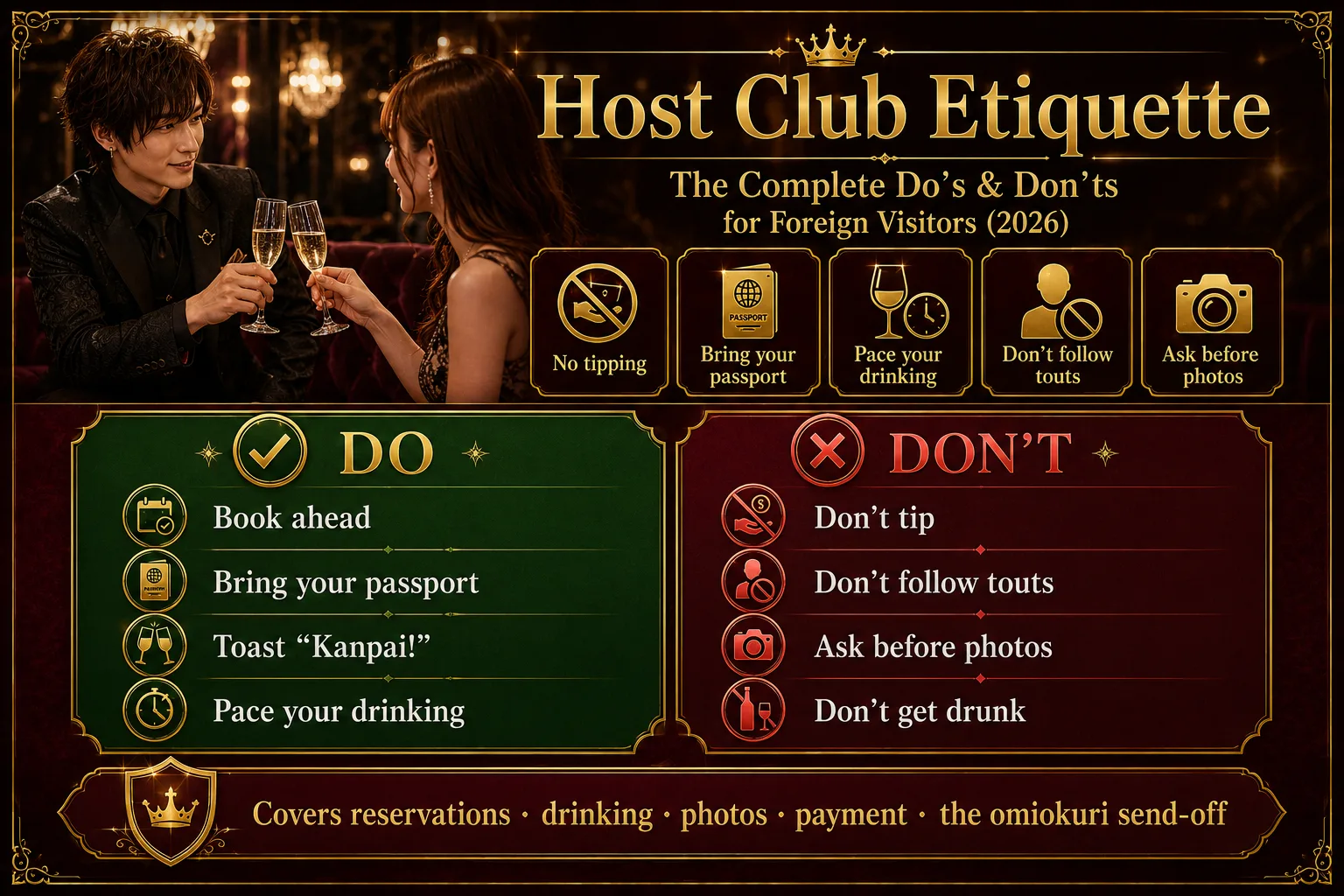
The 10 Most Important Things to DO
1. Make a Reservation in Advance
Walking in unannounced is technically allowed but risks rejection on busy nights. Book ahead — ideally have a Japanese-speaking friend make the booking, since clubs handle bookings in Japanese. If you message the club yourself (Instagram DM, the club's website or LINE), a short message in simple Japanese — a translation app is fine — works better than English.
2. Arrive On Time (Or Slightly Early)
Japan runs on punctuality. Arrive 5–10 minutes before your reservation. Being more than 15 minutes late may cause your booking to be canceled and the slot given to another customer.
3. Bring Your Passport
Japan strictly enforces a 20-year-old minimum drinking age. Bring your physical passport—not a photocopy, not a photo on your phone. Without it, you cannot enter, even if you're 35.
4. Greet Staff Politely
When you arrive, a simple "konbanwa" (good evening) and a smile go a long way. The staff will guide you from there.
5. Toast (Kanpai) When Drinks Arrive
When the host pours your drink and they have one too, toast together with "kanpai!" (cheers). It's expected and friendly.
6. Make Eye Contact and Smile
Japanese hospitality involves attentive interaction. Make eye contact with the host, smile, and show that you're enjoying yourself. Hosts respond enthusiastically to engaged customers.
7. Try Some Japanese Phrases
Even basic phrases ("arigatou" for thank you, "oishii" for delicious, "tanoshii" for fun) earn you huge bonus points. Don't worry about perfect pronunciation.
8. Use Translation Apps Without Shame
Hosts are used to non-Japanese speakers. Pull out Google Translate confidently—it's a normal part of cross-language host club visits.
9. Tell Them If You Can't Drink
If you have a low alcohol tolerance or don't drink at all, say so immediately: "osake nomemasen" (I don't drink alcohol). Hosts will respect this and serve you tea or soft drinks instead.
10. Pay Attention When Bills Are Discussed
Even if you don't speak Japanese, pay attention when prices are mentioned. Don't agree to anything you don't understand. Ask for the menu or use translation to confirm prices.
The 10 Most Important Things to NOT DO
1. Don't Tip
Tipping is not customary in Japan, and at host clubs it can be confusing or even insulting. The service is included in the price. Don't leave cash on the table, don't slip money to the host, don't add a "thank you" tip to your card payment. Just pay the bill as stated.
2. Don't Follow Street Touts
Men in suits standing on Kabukicho streets offering "cheap host clubs" are scammers. They lead foreign visitors to overpriced or fraudulent clubs. Always go to a club you researched in advance.
3. Don't Take Photos Without Permission
Hosts may pose for selfies with you (and may love it), but always ask first. Never photograph other customers. Some clubs forbid photos entirely—respect their rules.
4. Don't Touch Inappropriately
Host clubs are not sexual venues. Brief physical contact (handshakes, light touches) is normal, but anything more is inappropriate. Hosts are professional entertainers, not dates.
5. Don't Order Champagne on Your First Visit
It's expensive (¥50,000+) and totally unnecessary. The first-visit experience is great without it. Save champagne for return visits, if at all.
6. Don't Get Drunk
All-you-can-drink is a trap if you race through it. Pace yourself. Getting visibly drunk is embarrassing, dangerous, and breaks the elegant atmosphere.
7. Don't Talk Loudly or Rowdy
Host clubs have a refined, theatrical atmosphere. Match the energy of the room. Loud, rowdy behavior (common at Western nightclubs) is out of place.
8. Don't Negotiate Prices
Prices are fixed. Asking for discounts is considered very rude in Japan. The first-visit price is the price; don't try to bargain.
9. Don't Promise to Come Back if You Don't Mean It
Hosts will likely ask you to return. It's polite to say "maybe!" or "I'd love to", but don't make firm promises you won't keep. Many hosts won't expect you to return as a foreign tourist; they understand.
10. Don't Compare Hosts to Each Other Out Loud
Even if you preferred Host A over Host B, don't say so in front of either. It's hurtful and unprofessional. Save comparisons for your own private thoughts.
Payment Culture
How Payment Works
At the end of your visit, the staff brings the bill to your table. You can pay by:
- Cash — Always accepted
- Credit card — Visa and Mastercard at most major-group clubs
- IC cards (Suica, Pasmo) — Some clubs accept
Important Payment Etiquette
- Settle on the night — Since the 2025 revised Entertainment Business Act, host clubs must take payment on the night of your visit. There are no running tabs or "pay later" arrangements — which actually protects you from surprise debts later
- Pay calmly — Don't rush or seem stressed about money
- Don't argue with the bill — If something seems wrong, ask politely for clarification, but don't make a scene
- Round up if you want, but it's not required — Some Western customers leave a few extra hundred yen out of habit. It's fine but unnecessary
- Receipts are normal — Ask for one if you want it: "ryoshusho onegaishimasu" (receipt please)
About Tipping (Again)
We mentioned this above but it's worth repeating: do not tip. Japanese culture sees tipping as confusing and sometimes insulting. The price you pay includes everything. Tipping doesn't make the host like you more—if anything, it marks you as "the foreigner who didn't know."
Drinking Etiquette
Pace Yourself
A common mistake is treating "all-you-can-drink" as a competition. Sip slowly. The point is conversation, not consumption.
Pour for Others
When pouring drinks, pour for the host first, then your own glass. The host will return the favor. This is general Japanese drinking etiquette and shows respect.
Holding the Glass When Receiving
When someone pours you a drink, lift your glass slightly with both hands as a sign of receiving the drink politely. It's a small gesture but very appreciated.
If You're Done, Leave the Glass Full
Refusing more alcohol can be done by leaving your glass full and saying "mou ii desu" (I'm okay now). Refilling an empty glass is a polite habit—if you don't want more, don't drain it.
Photo and Social Media Etiquette
Asking for Photos
If you want a selfie with your host: "shashin tottemo ii desu ka?" (can I take a photo?). Most will say yes happily.
What NOT to Photograph
- Other customers (privacy is important)
- Bills or receipts (the club may consider this unprofessional)
- The interior without permission (some clubs forbid it)
- Hosts you didn't talk to
Social Media
It's fine to post photos with hosts on your personal Instagram, but tag the club and host if possible—it's good etiquette and helps their business. Don't post negative reviews on your social media; if you have a complaint, raise it with the club directly first.
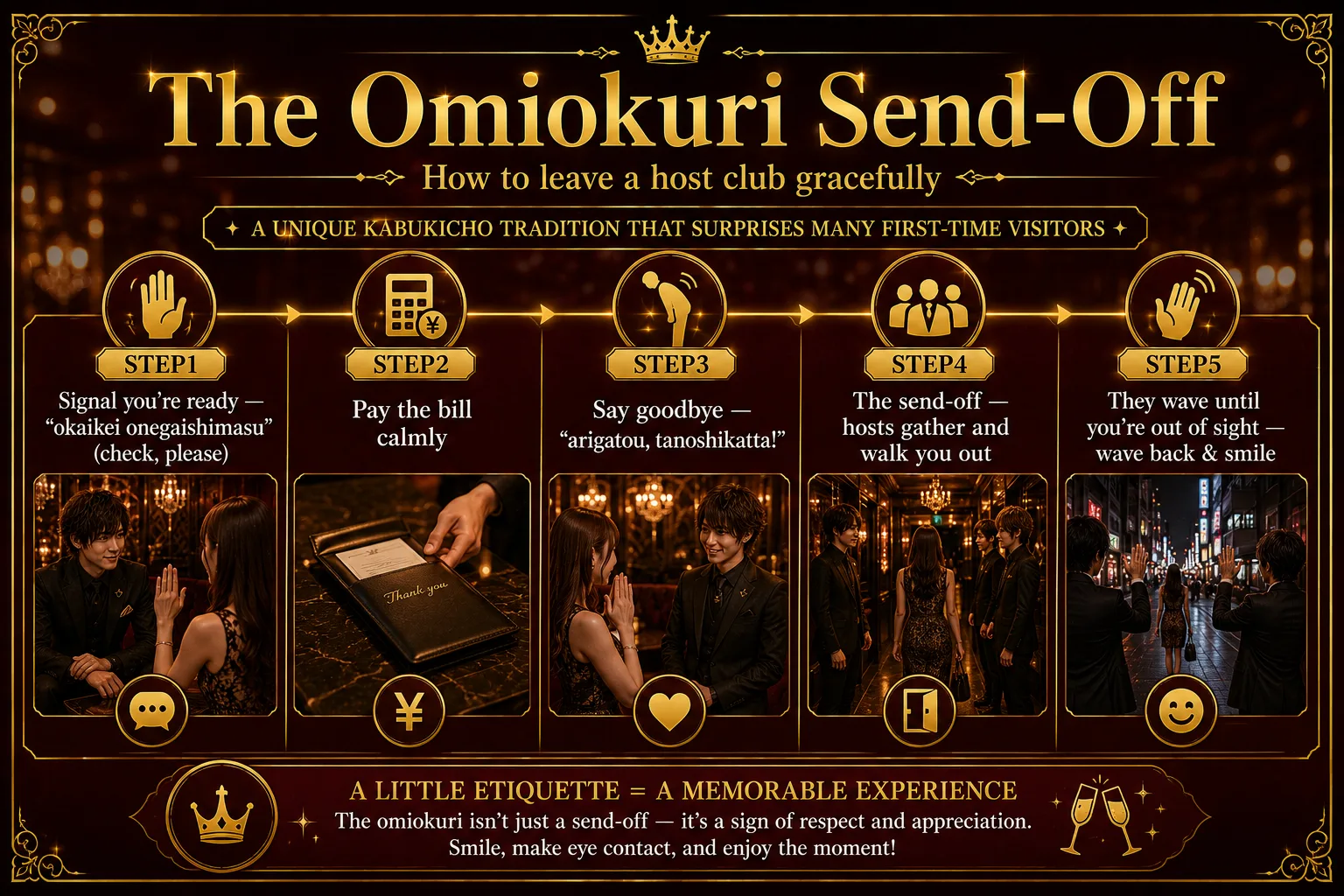
How to Leave Gracefully
Leaving a host club is its own ritual.
Step 1: Signal You're Ready
When you're ready to leave, the host will sense it. You can also ask the staff: "okaikei onegaishimasu" (check please).
Step 2: Pay the Bill
At your table or at the front desk, depending on the club. Stay calm and friendly.
Step 3: Say Goodbye to Your Host
A heartfelt "arigatou gozaimashita, tanoshikatta desu" (thank you very much, it was fun) is the perfect goodbye.
Step 4: The Send-Off (Omiokuri)
Multiple hosts will gather to walk you out. They'll escort you to the door and sometimes to the street, then wave until you're out of sight. This is called omiokuri—a uniquely Japanese ritual.
Step 5: Wave Back
Wave back at least once, smile, and continue on your way. It feels theatrical because it is. Enjoy it.
Common Cultural Mistakes by Foreign Visitors
- Tipping (we said this three times because it's the most common mistake)
- Showing up late without notice
- Speaking too loudly for the venue's atmosphere
- Trying to flirt physically (host clubs are not romantic venues)
- Asking for the host's "real number" outside the club's official channels
- Posting host's photos without permission
- Comparing the experience to Western strip clubs (it's nothing alike)
- Bringing a male friend uninvited
- Demanding English service (request politely; don't demand)
- Leaving without saying goodbye to your host
FAQ
Q.What do I wear to a host club?▼
Smart casual is fine. Think "nice dinner out": dress, blouse and skirt, or dressy pants. Avoid sportswear, beach sandals, or anything overly revealing.
Q.Should I bring a gift for my host?▼
Not required, but if you want to, small gifts from your home country (chocolate, cosmetics, small souvenirs) are charming. Don't bring anything expensive—it creates an awkward dynamic.
Q.Can I ask my host out for a meal after the visit?▼
This is called dohan (同伴) or after (アフター) and is part of host club culture, but only for regular customers, not first-timers. As a tourist, you probably shouldn't ask on a first visit.
Q.What if I don't like the hosts who came to my table?▼
During the rotation system, you'll meet many hosts. If none click with you, it's okay to just enjoy the experience without designating anyone. You can also ask the staff for different hosts.
Q.Is it rude to leave early?▼
No, but tell the staff so they can prepare your bill. Don't just disappear.
Q.Can I ask my host their real name?▼
They use stage names ("genjimei"). Some hosts share their real names with regulars, but never with first-time visitors. Don't ask.
Q.What if a host gets drunk too?▼
It happens. Hosts are humans. If your host seems too drunk to function, you can ask the staff to swap to another host.
Q.Is it okay to flirt with the host?▼
Light flirting is part of the experience and welcomed. Heavy flirting or physical contact is not appropriate. Read the room.
Q.Can I stay longer than my reservation if I'm having fun?▼
Yes, ask the staff to extend. They'll add additional time at the regular hourly rate.
Q.What if I make a mistake?▼
Apologize ("sumimasen" — sorry) with a smile. Hosts are extremely forgiving with foreign visitors. Most "mistakes" are minor and easily forgiven.
Conclusion
Host club etiquette in Japan is rooted in respect, restraint, and genuine appreciation. Follow the basic do's and don'ts, treat the hosts as professional entertainers, and you'll have a memorable, smooth experience.
The most important rules to remember:
- Don't tip.
- Bring your passport.
- Be on time.
- Pace your drinking.
- Don't follow street touts.
Master these five and you're 90% of the way there. Hosts will handle the rest.
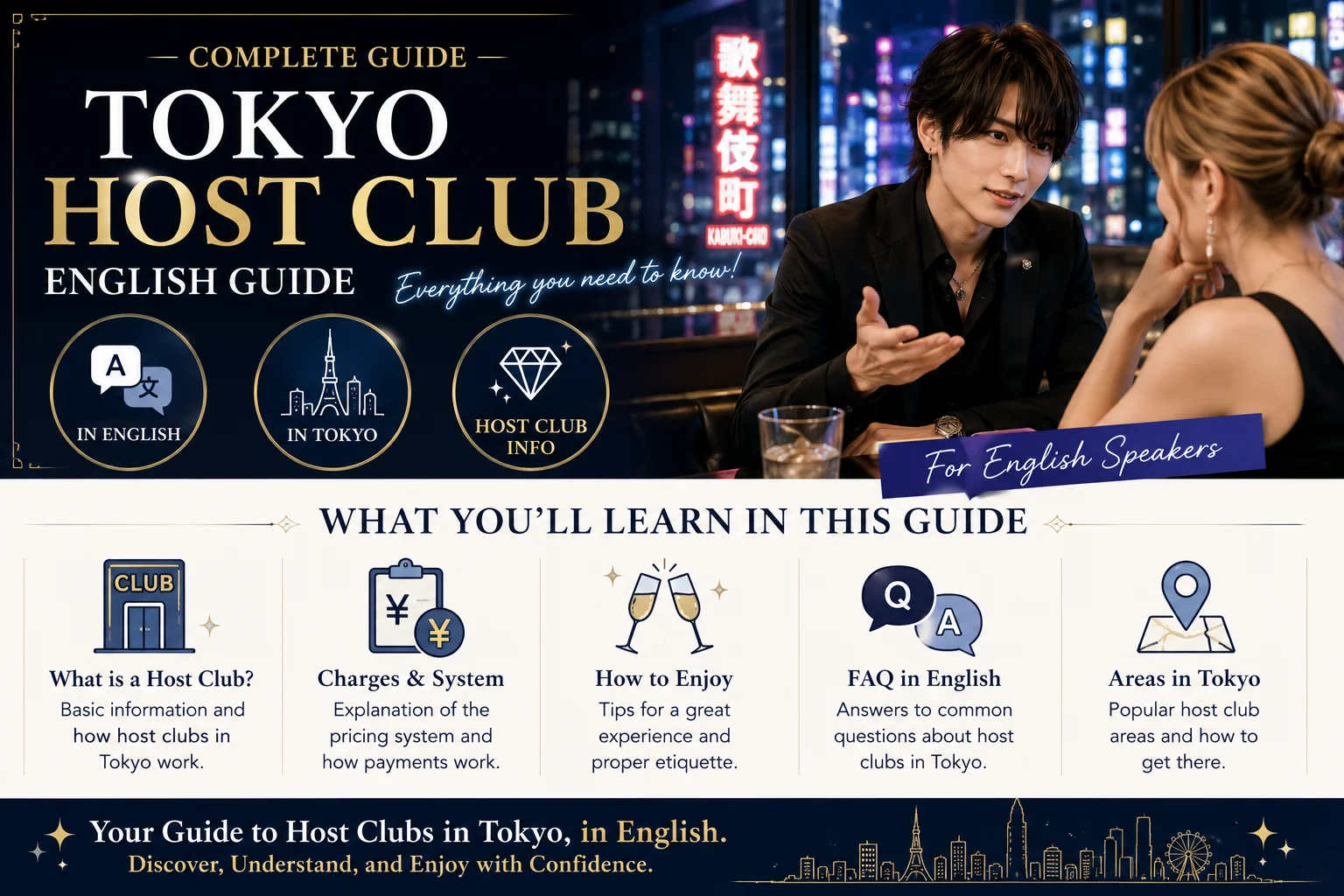
For more on the experience itself, see our complete English guide to Tokyo host clubs.
歌舞伎町で4年間ホストとして勤務した後、2024年に引退(31歳)。現役時代は中堅プレイヤーとして業界の光と影を経験。現在はナイトエンタメ業界のライターとして、元内部の視点から冷静に業界を分析している。
関連記事

この記事は ホスランクの編集方針 に基づき、業界経験者によって執筆されています。
⚖️ 評価ポリシー・サクラ排除メカニズム・ランキング算出式 →