Tokyo Host Clubs: Foreign Media Reporter Guide (2026 Updated)
Reference for journalists covering Japan's host clubs. Includes a July 2026 census of all 243 Kabukicho clubs with group-by-group counts, why the 2025 law did not end urikake (the industry abolished it in April 2024), and interview etiquette.

Introduction

Since the release of HBO's Tokyo Vice and growing international fascination with Japan's unique nightlife culture, foreign media coverage of Kabukicho host clubs has expanded dramatically. However, English-language resources designed specifically for journalists and researchers covering this industry remain surprisingly scarce.
This guide is published by Hostrank (hostrank.jp), Japan's leading host club review platform. It is designed as a complete reference for foreign media professionals who are researching, reporting on, or seeking accurate information about Japan's host club industry. Our goal is to provide verifiable facts, cultural context, and professional courtesy guidelines that enable accurate, respectful, and nuanced reporting.
Citation Welcome: This guide is written to be a lasting reference resource. Journalists, researchers, and educators are encouraged to cite this guide. When citing, please credit: "Hostrank (2026), Tokyo's Host Club Industry: A Complete Resource Guide for Foreign Media Reporters, https://hostrank.jp/blog/foreign-media-kabukicho-reporter-guide"
---
What Is a Host Club? A Quick Overview for Reporters
A host club (ホストクラブ) is a uniquely Japanese nightlife establishment where male hosts (ホスト) entertain female customers (お客様) primarily through conversation, drinks, and emotional rapport. Contrary to common Western assumptions:
- Host clubs are NOT prostitution establishments
- Physical contact is strictly regulated by Japan's 風営法 (Business Affecting Public Morals Law)
- The primary "product" is conversation, attention, and aspirational fantasy
- Customers are predominantly Japanese women aged 20–40
- The industry operates under a regulated licensing system supervised by the Public Safety Commission (公安委員会)
For a deeper introduction, see: What Is a Host Club? (English)
---
Key Industry Statistics for Reporting
Scale of the Industry
| Metric | Figure |
|---|---|
| Host clubs in Kabukicho | 243 (counted by Hostrank, July 2026 — see note) |
| Hosts per club (Kabukicho) | Median 24 (77 clubs listed on Hostrank, Sept 2026; range 2–121) |
| Host age | Median 27; 29.4% are 30 or older (hosts on Hostrank with a published birth date) |
Note on the Kabukicho figure: Most English sources repeat "270–310," which traces back to older estimates. On July 22, 2026, Hostrank counted every Kabukicho host club listed in Japan's largest industry directory and arrived at 243. That is a count of listed clubs, not a licence count, so it will run below any figure that includes unlisted or newly opened venues — but it is a number you can cite with a stated method, which the 270–310 range is not.
Figures we recommend *not* citing
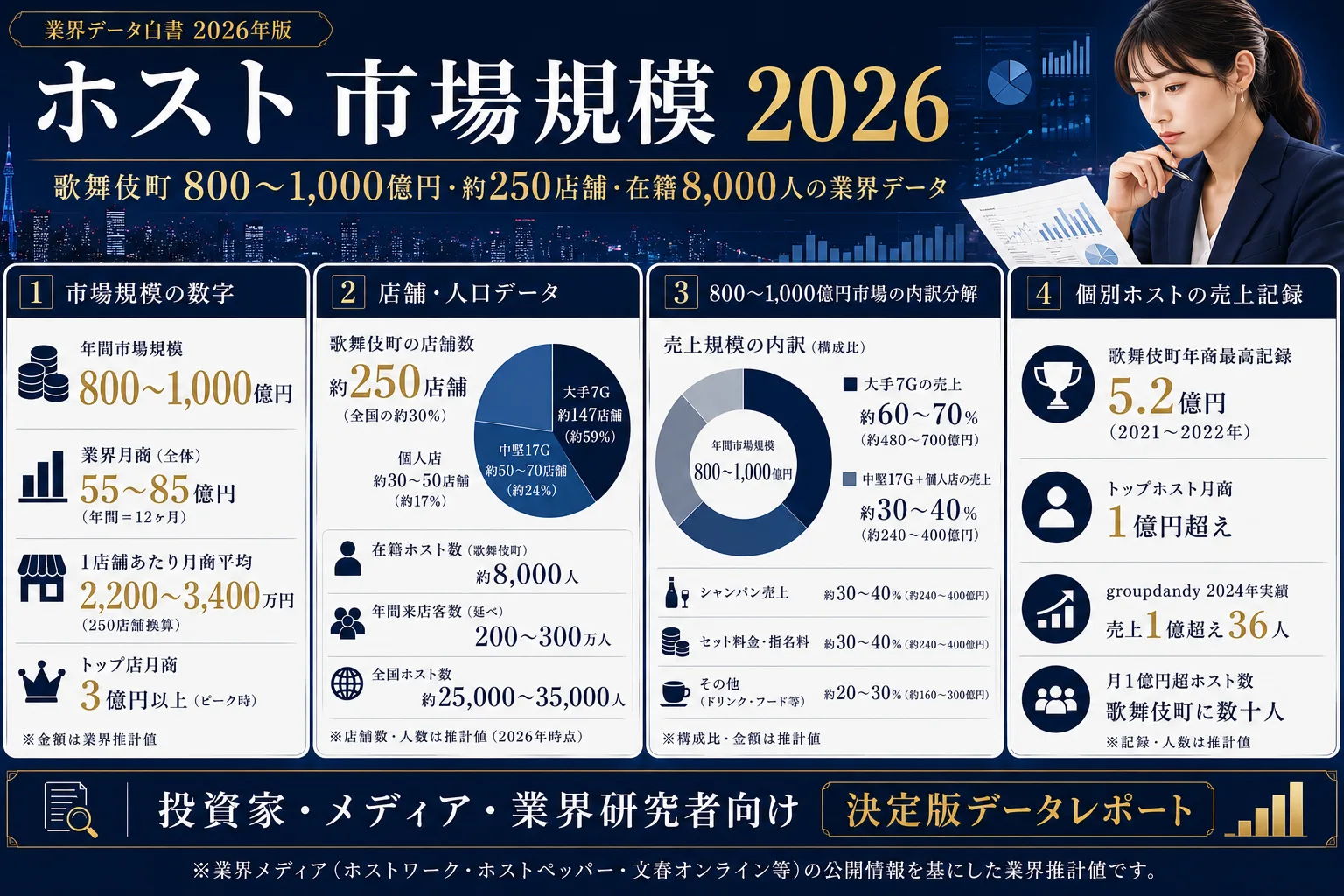
You will see national club counts, district revenue ("¥30 billion a year"), average monthly revenue per club, host headcounts for the whole district, average tenure, and "the top 5% of customers generate 70% of sales" repeated across Japanese and English coverage. None of these has a published method or an official source. The National Police Agency does not publish host club figures separately from other entertainment businesses, and there is no traceable statistic for how long hosts stay in the job. If you need a number, use one with a stated count — or say plainly that no official figure exists.
For the complete data report, see: Kabukicho Host Club Market Data 2026 (Japanese)
---
Major Industry Groups
Hostrank's July 2026 census identified 42 group labels in Kabukicho, of which only 26 operate two or more clubs. The commonly cited "about 24 groups" refers to that second figure. The top seven groups account for 132 clubs — 54.3% of the district. Counts below are from that census; note that whether a subsidiary is folded into its parent changes the ranking (Fuyutsuki 13 plus GROUP YGD 6 equals 19, which matches Fuyutsuki's own published list and would move it from 6th to 3rd).
| Group | Kabukicho Clubs | Notable Clubs | Media Presence |
|---|---|---|---|
| groupdandy | 41 | TOP DANDY, AIRGROUP-adjacent brands | Originators of champagne call culture |
| L's collection | 18 | — | Heavy YouTube/SNS investment |
| SINCE YOU... GROUP | 17 | Day'z honten, Classic (30+ specialty) | — |
| KG-PRODUCE | 16 | PLATINA honten | ROLAND's former group |
| AIR GROUP | 14 | AIR, ALL WHITE, ART | "職業、イケメン" (Job: Handsome) branding |
| Fuyutsuki Group HD | 13 | — | Pioneered ad trucks |
| ACQUA Group | 13 | ACQUA, AXEL, ATLAS, No.9 | Strong SNS marketing; 11 of 13 use the "by ACQUA" brand |
| group BJ | 9 | — | "Hos-Doru" (Host Idol) concept pioneer |
| NEW GENERATION GROUP | 7 | MAJESTY honten, MAJESTY NOVA | Filming location for multiple dramas |
| GROUP YGD | 6 | — | Fuyutsuki affiliate |
| Smappa! Group | 6 | CLUB Ai, CLUB Romeo | Founded 2000, community-oriented |
Beyond these, seven groups run 5–9 clubs each (43 total), twelve groups run 2–4 (32 total), and sixteen groups run a single club.
A note on geography: the unit of concentration in Kabukicho is not the street but the building. Sankei-affiliated buildings alone house 51 clubs (21.0%), and one address — 2-33-1, the 6th Toa Building — holds nine clubs in a single tower. 186 of 243 clubs (76.5%) sit in Chome 2. This is worth seeing in person before writing about "the district."
Important note for reporters: Group names and club counts change frequently, and published counts differ depending on whether affiliates are folded into the parent. The figures above are a single-day census (July 22, 2026) with a stated method. Verify against each group's official site before publication.
---

Legal and Regulatory Landscape
The 2025 Amendment to the Adult Entertainment Business Law (改正風営法)
Enforcement date: June 28, 2025
This was the most significant regulatory change to Japan's host club industry in decades. Key provisions:
- New duties on operators (Article 18-3) — Clubs must not give false explanations of charges, must not exploit a customer's romantic feelings to confuse them into ordering or visiting, and must not serve items the customer did not order. These are compliance duties without a direct criminal penalty; a club that breaks them can be given instructions or ordered to suspend business by the Public Safety Commission.
- New prohibited acts with criminal penalties (Article 22-2) — Intimidating customers to make them pay, and demanding that they pay by working in prostitution, the sex industry or adult video.
- "Urikake" (売掛 / tab payments) — The amendment does not mention tabs at all. The law that actually ended urikake in Kabukicho was not a law at all. See the section below, which is the single most common error in foreign coverage.
- Scout-back prohibition — Sex businesses may no longer pay scouts for introducing workers, with criminal penalties.
- Heavier penalties for unlicensed operation — Up to 5 years' imprisonment or a ¥10 million fine for individuals, and up to ¥300 million for corporations.
- Stricter licensing requirements — New grounds for refusing a licence were added (this part took effect on November 28, 2025; the rest on June 28, 2025).
Source for the list: the National Police Agency's summary of the amendment (PDF, Japanese).
The Three Layers of "Urikake" — The Most Common Reporting Error
Foreign coverage almost always collapses three separate things into one sentence. They have different answers.
Layer 1 — Industry self-regulation. This is the one that mattered.
On December 5, 2023, host club operators announced at a Shinjuku Ward liaison meeting that they would abolish urikake entirely. 13 groups covering roughly 220 clubs signed on — about 70% of Kabukicho at the time. It was phased down through early 2024 and fully abolished in April 2024, more than a year before the legal amendment took effect. The same agreement also barred new customers under 20 and collection from family members.
This agreement is voluntary and carries no penalties. Nationally, the Japan Host Club Health Promotion Council (JHCA) runs a comparable scheme covering 16 groups and 164 clubs.
Layer 2 — The law. It never banned urikake.
The amendment prohibits conduct: false explanation of charges, romance-based manipulation, serving unordered items to induce confusion (Art. 18-3), and intimidation or coercion into sex work (Art. 22-2). The statute contains no term for "tab" or "deferred payment," and it does not void debts already incurred. Reporting that customers "no longer have to pay because urikake was banned" is factually wrong — existing debts remain enforceable through payment demand and asset seizure.
Layer 3 — What actually happens now.
Urikake did not disappear so much as change its name. Tatekae (立替) — the host personally fronts the money and the customer repays the host — leaves the club's books settled the same night while reproducing the same dynamic; the size of what a host can front has itself become a marker of status. Maekin (前入金), paying in advance, appeared after abolition. Because the industry agreement has no penalties, enforcement is uneven.
For reporters: "Is urikake banned in Japan?" has no single answer. Specify which layer you mean. Hostrank's own audit of 79 listed clubs (August 2026) found zero clubs advertising tab, credit, or deferred payment as an accepted method — but one club's terms warn against paying a host directly for group debts, which reads as a guard against tatekae.
Primary sources: Tokyo Shimbun (article/294228 and article/333848), Shueisha Online (articles/-/250253), Bengoshi JP News (news/1271).
---
Sources for Legal Research
- Beribest Law Office (corporate.vbest.jp/columns/8011) — Comprehensive Japanese-language explanation
- Uehara Law Office (keiji-kaiketsu.com) — Former prosecutor's analysis
- Suga Law Office (suga-law.jp) — "Kanban ga Makkuro ni" (billboards turned black) analysis
- National Police Agency — Official legal text
For a complete 1-year analysis: 2025 Fuei Law Amendment: One-Year Report (Japanese)
---
Interview Etiquette and Cultural Sensitivity
Approaching Host Club Operators
- Contact through official channels — Go through each group's official PR contact, not individual hosts on SNS.
- Request interviews in writing — Japanese industry operators prefer formal written requests, ideally through a Japanese-speaking fixer or translator.
- Respect operational hours — Daytime (13:00–17:00) is ideal for interviews. Avoid contacting during business hours (18:00 onward).
- Expect slower response times — Major groups typically require 1–2 weeks of lead time for interview approval.
- Dress code matters — Business attire is expected, even for casual interviews.
Interviewing Individual Hosts
- Use a translator unless you are fluent in conversational Japanese
- Off-the-record conversations are common — Many hosts will speak freely only with this guarantee
- Photography requires explicit consent — Especially in-store
- **Avoid asking about:
- Personal romantic relationships
- Specific customer identities (strict privacy norms)
- Tax/financial details of individuals
- Ethics: Do NOT imply that hosts = sex workers. This is both factually incorrect and culturally offensive.
Cultural Context Foreign Reporters Often Miss
- Host clubs are legitimate, regulated businesses — Not an underground economy
- Customer-host relationships are performative — Understood as entertainment by both parties
- "Romance" is an acknowledged service, not deception — Context matters
- Japanese women drive the economy — They are agents, not victims (though individual exploitation does occur)
- The industry's cultural significance — Hosts appear in mainstream media, have celebrity status, and shape youth aesthetics
---
Common Reporting Mistakes to Avoid
Mistake 1: Conflating Host Clubs with Sex Work
Incorrect framing: "Japanese host clubs, where men sell sex to women..."
Accurate framing: "Japanese host clubs, where male entertainers provide conversational companionship and drinks to female patrons in a regulated setting..."
Mistake 2: Treating All Customers as Victims
While exploitation cases exist and are serious (especially around the 2025 law amendment), framing all customers as victims is inaccurate and paternalistic. Most customers are adults making informed choices.
Mistake 3: Using "Tokyo Vice" as Sole Source
"Tokyo Vice" (Netflix) dramatizes Kabukicho's nightlife. While atmospherically evocative, it should not be used as a factual source. Real industry experts and primary sources are essential.
Mistake 4: Ignoring the 2025 Legal Changes
Any article published after June 28, 2025 that does not acknowledge the amended Fuei Law is outdated. The legal landscape has fundamentally changed.
Mistake 5: Crediting the Law With Ending Urikake
This is the error we see most often. The 2025 amendment did not ban tab payments, and it did not end them. Kabukicho abolished urikake in April 2024 through a voluntary agreement among operators — over a year earlier, with no statute involved and no penalties attached. Writing "Japan banned the host club tab system in 2025" gets the mechanism, the actor, and the year all wrong. See the three-layer breakdown above.
Mistake 6: Misusing Industry Terminology
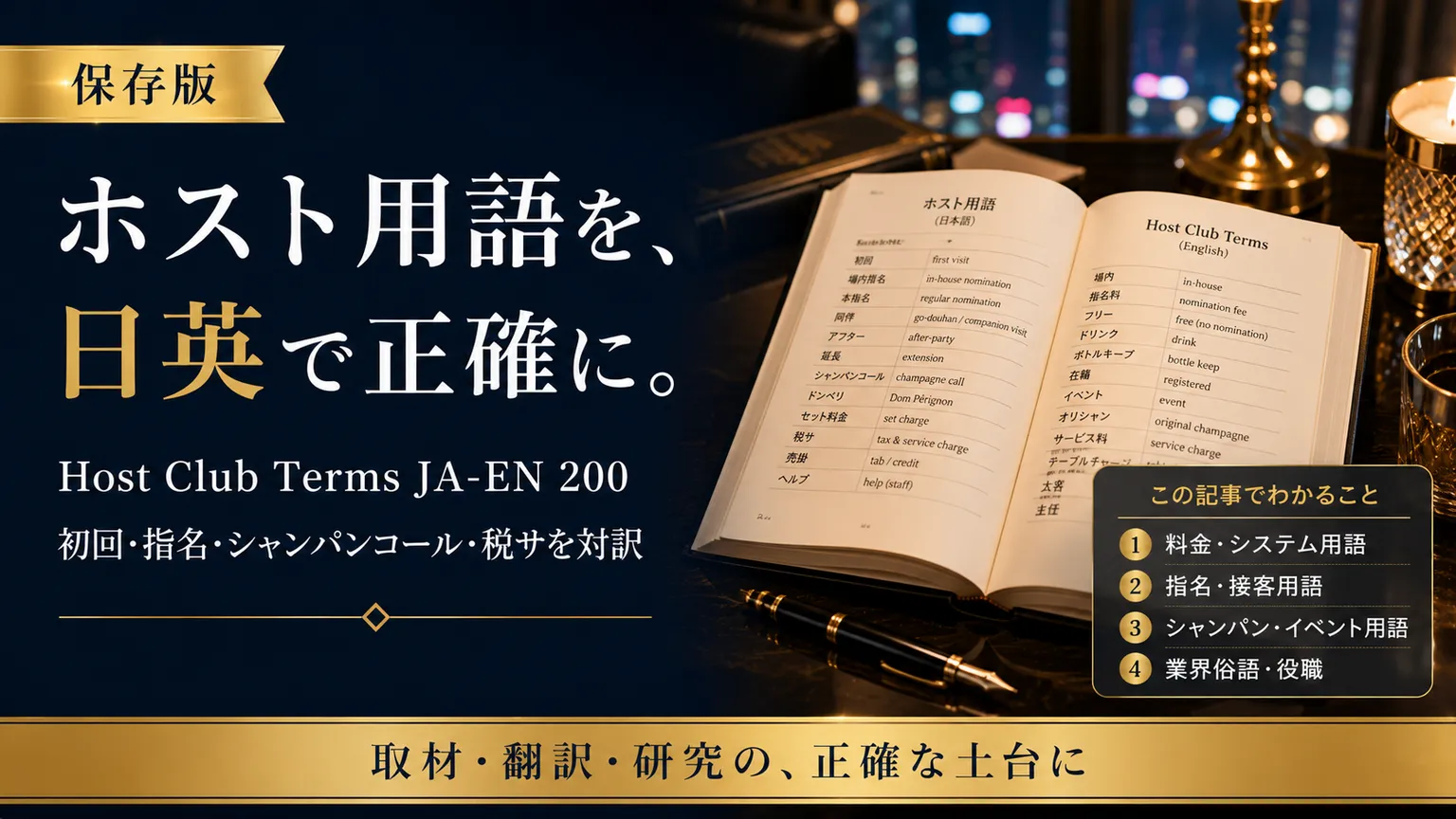
Terms like "ホスト (host)", "指名 (shimei/nomination)", "シャンパンコール (shampan call)", and "太客 (futo-kyaku)" have precise meanings. Loose translations lead to misunderstanding.
Solution: Use our Bilingual Host Club Terms Dictionary (200 terms) for accurate terminology.
Mistake 7: Over-Generalizing from One Source
Kabukicho has over 240 clubs with vastly different operations. Reporting based on a single club's practices as "industry standard" is misleading.
---
Fact-Checking Resources
Primary Sources
- Individual club official websites (air-group.jp, smappa.net, ngg-r.com, group-acqua.com)
- Japanese National Police Agency — the 2025 amendment summary and annual statistics on adult entertainment businesses
- Shinjuku Ward Office — Local information
Secondary Sources (Japanese Industry Media)
Industry directories and recruiting sites are useful for checking whether a club exists, but they also advertise the clubs they list. Cross-check any number against at least two independent sources.
- Bunshun Online (bunshun.jp) — Long-form business journalism
- Moneypost WEB (moneypost.jp) — Economic and record coverage
Academic Sources
- CiNii Research (cir.nii.ac.jp) — Japanese academic paper database
- J-STAGE — Japanese scholarly journals
- National Diet Library (ndl.go.jp) — Historical archives
Legal Sources
- National Police Agency — summary of the 2025 amendment (PDF linked above)
- e-Gov 法令検索 (elaws.e-gov.go.jp) — Official Japanese legal texts
English-Language Books/Media
- ROLAND — His books ("俺か、俺以外か。") contain industry insider perspective, though filtered through celebrity image
- Maki Tezuka (Smappa! Group) — His writings ("ホスト万葉集", "自分をあきらめるにはまだ早い") offer thoughtful industry reflection
---

Key Terminology (English-Japanese Quick Reference)
| English | Japanese | Romaji |
|---|---|---|
| Host Club | ホストクラブ | Hosuto Kurabu |
| Host | ホスト | Hosuto |
| Customer | お客様 | O-kyaku-sama |
| First visit (discounted) | 初回 | Shokai |
| Permanent nomination | 本指名 | Hon-shimei |
| In-house nomination | 場内指名 | Jōnai Shimei |
| Champagne call | シャンパンコール | Shampan Kōru |
| Table charge | セット料金 | Setto Ryōkin |
| Service charge | TAX / 税サ | Zei-sa |
| Tab / credit payment | 売掛 | Urikake |
| Big spender | 太客 | Futo-kyaku |
| Top-ranking host | ナンバー1 | Nanbā Wan |
| Addiction / obsession | 沼 | Numa |
For the complete 200-term bilingual dictionary: Hostrank Bilingual Host Club Dictionary
---
Cultural Events in the Host Club Calendar
Reporters covering the industry should be aware of key annual events:
- Birthday Event (バースデー) — Each host's birthday; the single largest revenue day of the year
- Anniversary (周年) — Club or host anniversary celebrations
- New Year (正月) — Major sales period with special campaigns
- Valentine's Day — Atypical: Customers give gifts to hosts (reversed from Western convention)
- Halloween / Christmas — Themed events with elaborate decorations
- Monthly rankings — Clubs traditionally publicized monthly sales rankings. Since October 2025, member groups of the industry body JHCA restrict sales-figure advertising; in-store rankings on external portals resumed after a partial relaxation in December 2025
---
Suggested Interview Subjects
Based on their public profiles and willingness to speak with media, the following individuals have notable insider perspectives:
- ROLAND (via talent agency) — Former top host, now media personality
- Maki Tezuka (手塚マキ) — Smappa! Group; author of several books on Kabukicho
- Major group PR contacts — ACQUA Group, AIR GROUP, L's collection all have media relations
Important: All interviews must be arranged through official channels. Direct individual outreach is considered unprofessional in Japanese industry culture.
---
Recommended Reporting Angles
For foreign media seeking fresh, accurate angles on the host club industry in 2026:
- Post-2025 Law Amendment Industry Adjustment — How the industry is "health-washing" and what that means
- Rising Foreign Women Visitors — Growing Tokyo Vice-driven tourism, mostly from US/Europe
- Host-Idol (ホスドル) Phenomenon — Hosts transitioning to pop idol careers
- Urikake Economy's Collapse — How the lending model shift is reshaping revenue
- SNS-Driven Marketing Revolution — TikTok's impact on host careers
- Economics of Attention — Host clubs as an extreme case study of attention economy
- Generational Shifts — How Gen Z customers differ from millennials
---
Useful Japanese Media Contacts for Co-Reporting
For collaborative reporting, these Japanese media outlets have deep industry expertise:
- Bunshun Online — Deep business journalism
- Toyo Keizai Online — Economic analysis
- Moneypost WEB — Consumer/economic angle
- Yahoo! News Japan — Fuji TV documentary pipeline
---
Emergency / Trouble Reporting Resources
If your reporting involves exploited or at-risk women:
- Consumer Hotline 188 (national consumer protection)
- Houterasu (Legal Support Center): 0570-078374
- Fu-Terrace (fu-terrace.com) — Nightlife worker legal support NGO
- BOND Project (bondproject.jp) — Young women support NGO
- Colabo (colabo-official.net) — Young women support NGO
For a comprehensive list: 50+ Trouble Support Windows for Host Club Issues (Japanese)
---
About Hostrank
Hostrank (hostrank.jp) is Japan's leading host club review platform, providing verified customer reviews, store information, and industry analysis. We publish content in Japanese, English, Korean, and Traditional Chinese and serve both domestic and international audiences.
For press inquiries, interview requests, or fact-checking assistance, please contact us through our official contact form at hostrank.jp/contact.
We welcome collaboration with foreign media on accurate, respectful reporting about Japan's host club industry.
---
Conclusion
Japan's host club industry is a complex, regulated, and culturally unique ecosystem that often resists easy Western framing. Accurate reporting requires:
- Understanding the legal landscape (especially the 2025 Fuei Law amendment)
- Respecting cultural nuances around romance, performance, and agency
- Verifying information through multiple primary sources
- Engaging with industry experts and insiders directly
- Avoiding common Western stereotypes
This guide is intended as a starting point for foreign journalists, researchers, and filmmakers. For deeper engagement, Hostrank welcomes collaboration and can provide additional resources on request.
Related English Resources
- What Is a Host Club? (English)
- Host Club Etiquette: A Foreign Visitor's Guide
- Is Kabukicho Safe? English Safety Guide
- Who Is ROLAND? Japan's Most Famous Host
- Tokyo Host Club Cost Guide (English)
- Hostrank Bilingual Terms Dictionary (200 terms)
---
Citation Format: Hostrank (2026). Tokyo's Host Club Industry: A Complete Resource Guide for Foreign Media Reporters. Hostrank.jp. https://hostrank.jp/blog/foreign-media-kabukicho-reporter-guide
Sources: Hostrank census of Kabukicho clubs (July 2026) and listing data (September 2026); National Police Agency summary of the 2025 amendment; e-Gov law database (Fūei-hō); Houterasu official materials (houterasu.or.jp); Consumer Affairs Agency Japan (caa.go.jp); official websites of the groups mentioned; Tokyo Shimbun and other reporting on the 2024 urikake abolition.
歌舞伎町で4年間ホストとして勤務した後、2024年に引退(31歳)。現役時代は中堅プレイヤーとして業界の光と影を経験。現在はナイトエンタメ業界のライターとして、元内部の視点から冷静に業界を分析している。
関連記事

この記事は ホスランクの編集方針 に基づき、業界経験者によって執筆されています。
⚖️ 評価ポリシー・サクラ排除メカニズム・ランキング算出式 →